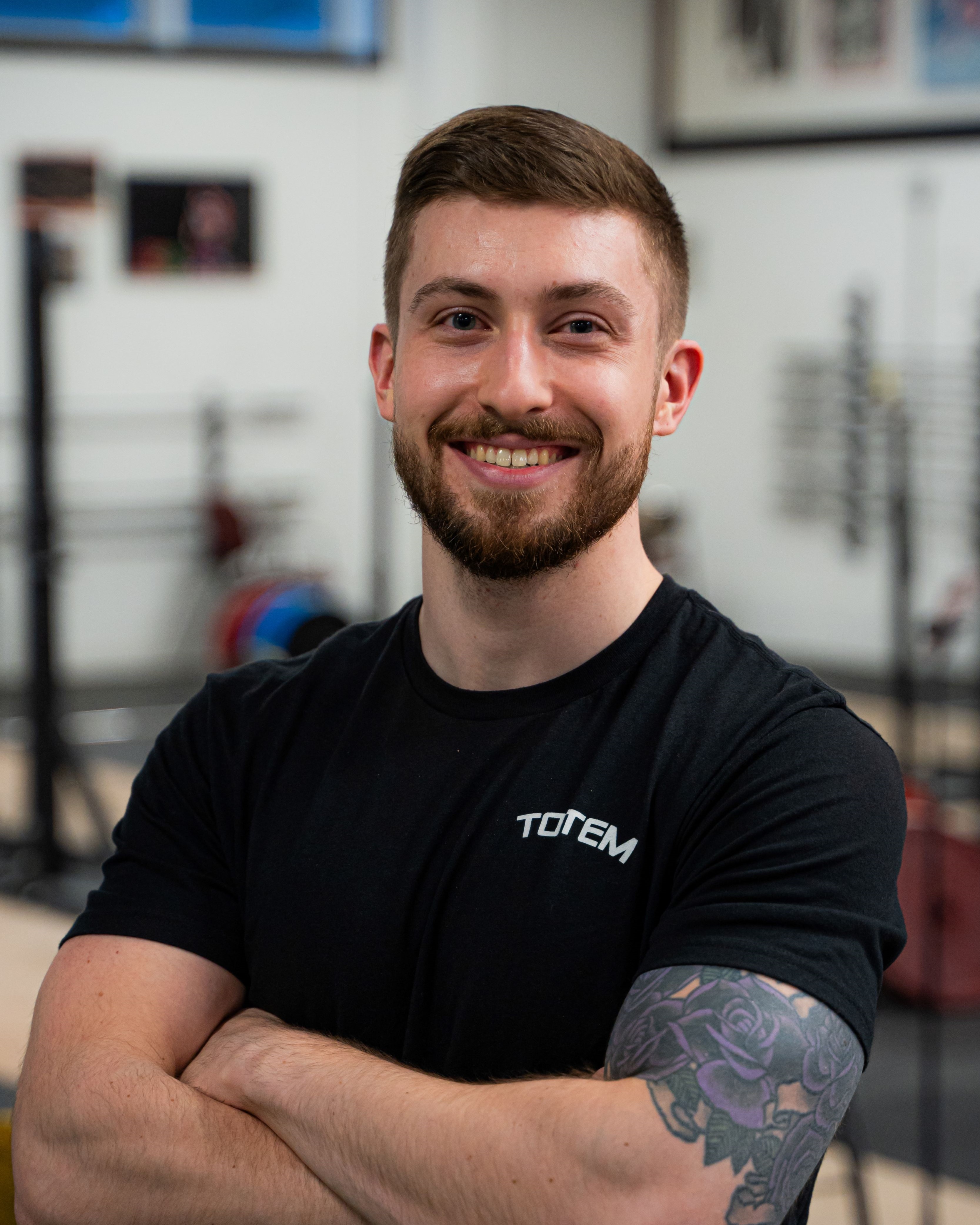
Tyler Boyd, PT, DPT, COMT, CSCS, BRM
Co-Owner, Doctor of Physical Therapy, Certified Strength and Conditioning Specialist

Busy schedules and travel don't have to derail your fitness goals. Learn practical strategies to maintain training consistency through flexible programming, efficient workouts, and smarter recovery. Discover how Totem's online coaching through TrainHeroic helps you stay on track wherever life takes you.
For busy professionals, maintaining a consistent training routine can feel like a challenge. Work deadlines, business trips, family commitments, and unpredictable schedules can quickly disrupt even the most established fitness habits.
It's easy to fall into an all-or-nothing mindset: if you can't complete your usual workout, you might as well skip it entirely.
But long-term progress doesn't require a perfect schedule. It requires a training approach that can adapt to your life.
Whether you're traveling for work, navigating a demanding season in your career, or simply struggling to find time for the gym, understanding how to stay consistent with training while traveling or managing a busy schedule can help you maintain progress without sacrificing your other responsibilities.
One of the biggest misconceptions about fitness is that every workout needs to be long, intense, or exhaustive to produce meaningful results.
In reality, maintaining strength and fitness often requires less training volume than building them in the first place.
During particularly busy periods, your goal may shift from maximizing progress to maintaining your current abilities.
Instead of abandoning your routine, consider temporarily reducing your training frequency or session duration.
For example, someone accustomed to four or five weekly workouts might transition to two or three focused sessions lasting 30–45 minutes.
By prioritizing fundamental movement patterns, maintaining appropriate exercise intensity, and reducing unnecessary volume, you can continue providing your body with a meaningful training stimulus.
The objective isn't to do everything. It's to consistently do what matters most.
Travel frequently introduces another challenge: limited or unfamiliar exercise equipment.
Your home gym might have everything you need, but a hotel fitness center may offer little more than a treadmill and a few dumbbells.
Rather than treating limited equipment as a reason to skip training, consider organizing your workouts around different equipment options.
Full Gym Access
When you have access to a complete training facility, continue following your normal program with your primary strength exercises, accessory movements, and planned progression.
Limited Equipment
When only dumbbells, cables, or resistance bands are available, substitute exercises that challenge similar muscle groups and movement patterns.
For example, a barbell squat might be replaced with a goblet squat or split squat. While the loading potential may differ, these movements can still provide an effective training stimulus.
Minimal or No Equipment
Bodyweight exercises, single-leg movements, push-up variations, and simple conditioning circuits can help maintain activity when traditional equipment isn't available.
These sessions may not perfectly replicate your usual training, but they can preserve momentum until you return to your normal routine.
The key is understanding that your training goals can remain consistent even when the exercises need to change.
A common mistake is trying to force an ideal training schedule into an unpredictable lifestyle.
Instead, evaluate your upcoming commitments and build a realistic plan around them.
At the beginning of each week, look at your work schedule, travel plans, and personal responsibilities. Identify the days when you have the greatest opportunity to train.
If Monday and Wednesday are packed with meetings but Tuesday and Friday offer more flexibility, build your training around those opportunities.
During travel, consider planning workouts before departure rather than hoping you'll find time once you arrive.
Even a brief review of your schedule can help you establish realistic expectations and reduce the likelihood that training becomes an afterthought.
Consistency is easier when your plan reflects the time you actually have available, rather than the time you wish you had.
Even the best schedules change.
Meetings run late, flights get delayed, and unexpected responsibilities arise.
Having a shorter alternative workout available can make the difference between maintaining your routine and skipping training entirely.
For example, if your planned 60-minute workout becomes unrealistic, a 20-minute session might include:
The movements, intensity, and total workload should be adjusted to your experience and goals.
The purpose of a fallback session isn't to replace every full workout. It's to provide a practical alternative when circumstances change.
A shorter, intentional workout is often more valuable than repeatedly postponing the perfect one.
Busy work seasons and travel don't just affect your schedule. They can also influence your ability to recover from training.
Poor sleep, extended periods of sitting, changes in nutrition, and increased psychological stress can all contribute to greater fatigue.
When these factors accumulate, attempting to maintain your usual training volume and intensity may become counterproductive.
Instead, pay attention to indicators such as persistent fatigue, declining performance, unusual soreness, and reduced motivation.
Depending on your circumstances, the best adjustment might involve reducing training volume, incorporating additional rest, or substituting a demanding workout with lower-intensity activity.
Walking, mobility work, and other forms of light movement can help maintain an active routine without adding substantial training stress.
Remember that rest and recovery aren't interruptions to progress. They're essential components of a sustainable training process.
When your schedule becomes inconsistent, it's easy to focus on the workouts you missed rather than the progress you've maintained.
Instead of measuring success exclusively by the number of sessions completed, consider other indicators of consistency.
These might include your training performance, weekly activity, exercise quality, recovery, or ability to maintain a realistic training schedule.
Tracking these variables provides a clearer picture of your progress over time.
It also helps you recognize patterns.
Perhaps your training consistency declines during certain work seasons, or you consistently struggle to complete longer workouts while traveling.
Identifying these challenges allows you to make proactive adjustments instead of repeatedly restarting your program.
At Totem Training and Performance, we believe effective training should support your lifestyle, not compete with it.
Our online training services are designed for individuals who want personalized programming, professional guidance, and ongoing accountability without being tied to a specific training location or schedule.
Our coaches utilize TrainHeroic, a dedicated training and coaching platform, to deliver structured programs tailored to your goals, experience, and available equipment.
Through TrainHeroic, you can access your workouts, log training performance, track progression, and stay connected with your coach wherever you're training.
If your schedule changes, you're traveling, or your equipment access becomes limited, your coach can make appropriate adjustments to help keep your training productive.
Rather than relying on random workouts or a rigid program that doesn't accommodate your circumstances, you receive a structured approach that evolves alongside your needs.
Our online coaching process emphasizes:
The result is a training experience that combines the flexibility of working out independently with the structure and direction of professional coaching.
Travel, demanding careers, and unexpected responsibilities are normal parts of life.
Your training program should account for that reality.
Instead of viewing disruptions as setbacks, approach them as opportunities to adapt your training strategy.
Sometimes that means completing a shorter workout, reducing your weekly training volume, or making the most of limited equipment.
Other times, it means prioritizing recovery and returning to your normal training schedule when circumstances allow.
What matters most is developing a sustainable routine that supports long-term progress.
At Totem Training and Performance, we help you build that routine through personalized online coaching that adapts to your schedule, your goals, and your life.
Ready to train with more structure and flexibility?
Request flexible online programming with Totem Training and Performance and discover how personalized coaching can help you stay consistent wherever life takes you.
Explore expert insights on physical therapy, strength training, injury recovery, and performance—designed to help you move better and stay pain-free long-term.