Tyler Boyd, PT, DPT, COMT, CSCS, BRM
Co-Owner, Doctor of Physical Therapy, Certified Strength and Conditioning Specialist

Compare bodybuilding vs powerlifting for strength, muscle, and long-term health—and learn which approach is best for you.
If you’re getting into lifting—or trying to take your training more seriously—you’ve probably asked this question:
Should I train like a bodybuilder or a powerlifter?
On the surface, they seem very different.
One focuses on aesthetics.
The other focuses on strength.
But when it comes to building a strong, healthy, and resilient body, the answer isn’t as simple as choosing one over the other.
It comes down to how your training is structured.
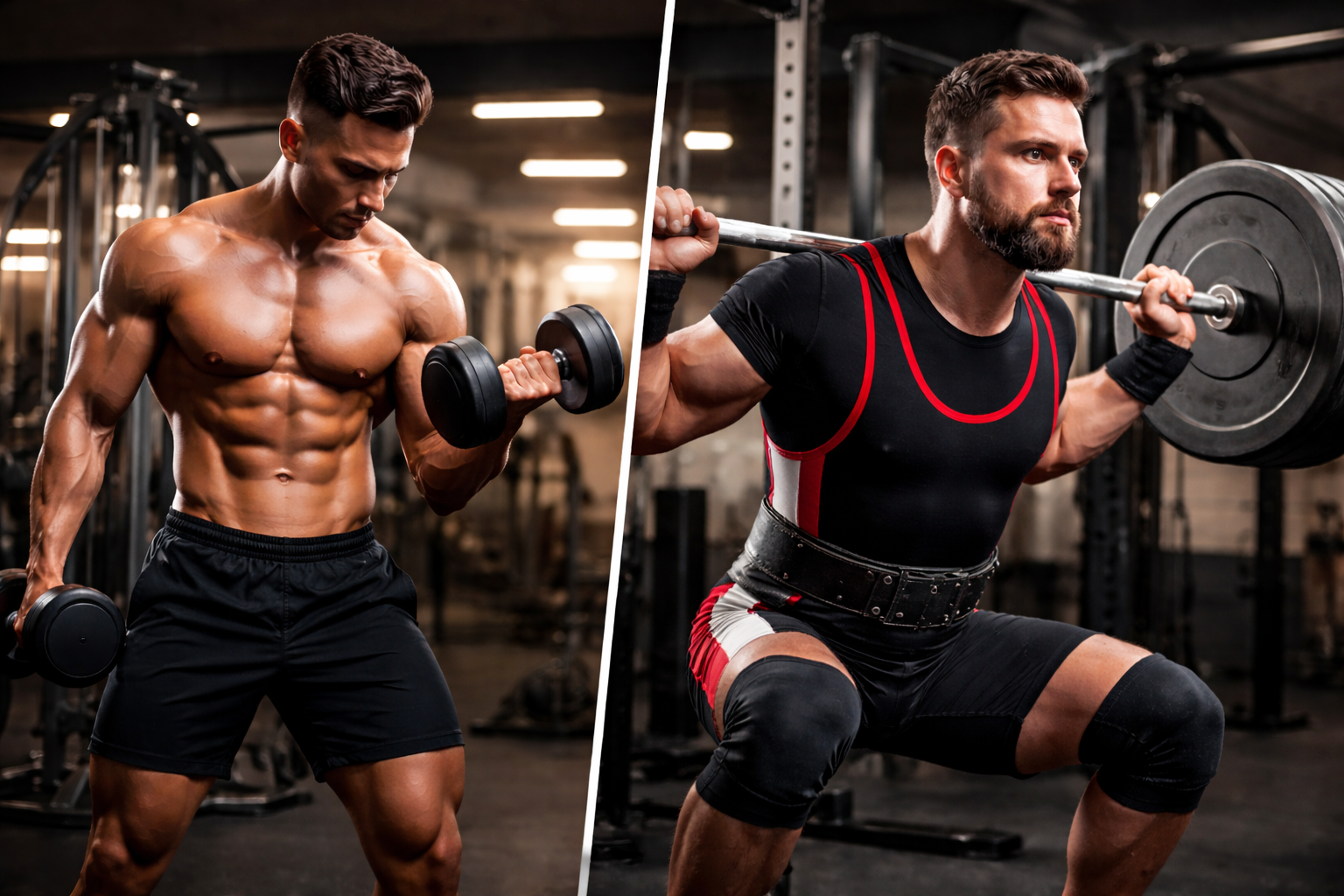
Bodybuilding is centered around hypertrophy—building muscle size, improving symmetry, and achieving a certain physique.
Powerlifting, on the other hand, is focused on maximizing strength in the squat, bench press, and deadlift.
Different goals—but both rely on the same fundamentals:
The difference lies in how those variables are applied.
Bodybuilding-style training typically emphasizes higher training volume with moderate to heavy loads. Workouts are often organized around muscle groups, using splits like push/pull/legs or upper/lower.
The goal is to create enough stimulus to drive muscle growth while maintaining control and precision in each movement.
Powerlifting training takes a different approach.
There’s more emphasis on lower volume but higher intensity, with the goal of building maximal strength in specific lifts. Accessory exercises are still used, but they serve a different purpose—developing weak points that carry over to performance in the main lifts.
Well-structured powerlifting programs—like conjugate or other periodized systems—also incorporate variation, speed work, and recovery strategies to continue progressing without burning out.
Bodybuilding-style training is highly effective for improving body composition, increasing muscle mass, and supporting metabolic health. It can also contribute to joint health when done with proper control and exercise selection.
Powerlifting builds strength that directly carries over to real-world movement. It improves bone density, joint stability, and your ability to produce force—something that becomes increasingly important over time.
Both approaches can improve your health.
Both can build muscle.
Both can make you more resilient.
The issue isn’t bodybuilding or powerlifting.
It’s how most people apply them.
With bodybuilding-style training, we often see overuse issues from excessive volume, repetitive movements, and lack of variation.
With powerlifting, the most common problem is pushing heavy weight too aggressively—without proper progression, recovery, or technique.
In both cases, the problem isn’t the method.
It’s the lack of structure.
The best results don’t come from strictly following one approach.
They come from combining the right elements of both.
You need:
This is where most lifters get stuck.
They bounce between programs, try to piece things together, or follow something that isn’t built for them.
If your training feels inconsistent, random, or no longer effective, it’s usually not a motivation problem.
It’s a programming problem.
Our online training programs are built to combine the most effective elements of strength and hypertrophy training into a structured system that actually drives progress.
Whether your goal is to:
…you need a plan that evolves with you.
Explore expert insights on physical therapy, strength training, injury recovery, and performance—designed to help you move better and stay pain-free long-term.